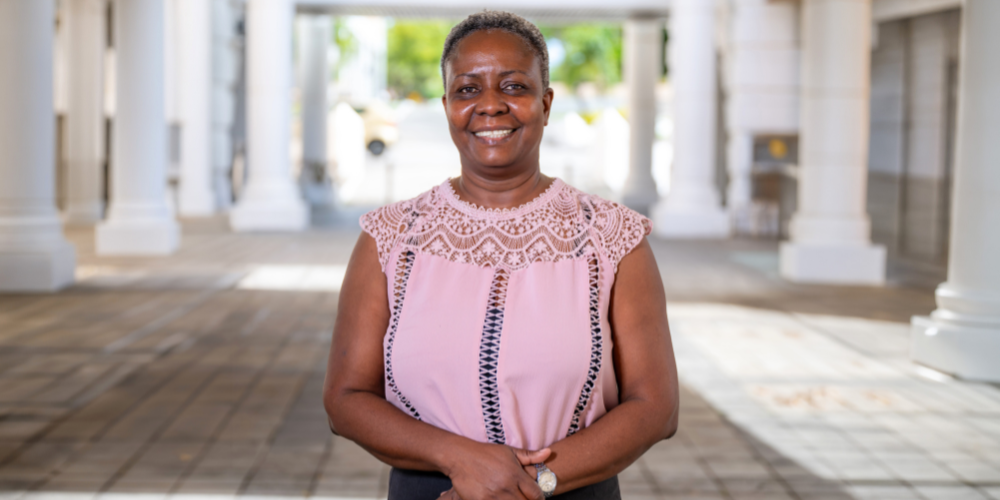
For Dr. Lindonne Telesford, research has never been an end in itself. It is a pathway to improving lives, informing policy, and helping Caribbean communities better prepare for the public health challenges of today and tomorrow.
That philosophy has shaped her career, from leading Grenada’s first study on the burden of foodborne diseases to pioneering research on environmental health, wastewater reuse, climate change adaptation, and One Health. Today, it also guides her newest role as interim dean of St. George’s University School of Graduate Studies (SGS), a position she assumed on July 1, 2026.
Her appointment comes at an exciting time for the School of Graduate Studies as it continues to expand interdisciplinary research, strengthen regional and international collaborations, and prepare graduate students to address increasingly complex global challenges. Drawing on nearly a decade as an SGU faculty member and a career dedicated to advancing Caribbean public health research, Dr. Telesford is focused on fostering a culture of innovation, expanding research opportunities, and equipping graduate students and faculty to make meaningful contributions both within the Caribbean and beyond.
“The Caribbean cannot afford to lag in generating the knowledge and evidence needed to solve its own public health challenges. Research is how we create solutions that are relevant to our region.” — Dr. Lindonne Telesford
A proud Grenadian and SGU alumna, Dr. Telesford earned her Master of Science in public health from SGU in 2009 before completing a Doctor of Public Health degree from Walden University. She joined SGU as an instructor in 2016 and currently serves as an associate professor in the Department of Public Health and Preventive Medicine in addition to her role as interim dean. Through her groundbreaking research and collaborations with regional and international organizations, she has become one of the Caribbean’s leading voices in environmental health and public health research.
SGU News spoke with Dr. Telesford about her vision for the School of Graduate Studies, her passion for research, and why developing Caribbean-led solutions is more important than ever.
SGU: You were recently appointed interim dean of the School of Graduate Studies. What are your priorities for the school over the coming year?
Dr. Telesford: The School of Graduate Studies has tremendous potential, and my priorities are focused on ensuring we continue to evolve to meet the changing needs of students, employers, and society.
That means ensuring our programs remain responsive to modern and emerging workforce demands while identifying niche areas that allow SGS to remain competitive. I’m also focused on strengthening partnerships with academic and non-academic institutions that enhance our teaching, research, and service, maintaining accreditation across our graduate programs, developing systems that support faculty in delivering graduate education, and ensuring the school’s long-term financial growth.
Ultimately, my goal is to position the School of Graduate Studies as a leader in graduate education that is innovative, responsive, and committed to excellence.
SGU: Much of your research focuses on environmental health, climate change, and One Health. Why are these issues especially important for the Caribbean?
Dr. Telesford: The relationship between our environment and human health is becoming increasingly evident, and the One Health approach recognizes that human, animal, and environmental health are deeply interconnected.
Climate change is one of the most significant determinants of health and quality of life across the globe, but its effects are often magnified in small island developing states like those in the Caribbean. Limited resources and capacity make our region especially vulnerable to natural disasters and other climate-related events.
This is why research is so important. Public health practitioners, academics, and researchers have a responsibility to generate evidence that reflects our regional realities. Without that knowledge, the Caribbean risks falling behind in developing effective, region-specific strategies that improve public health and strengthen resilience.
SGU: Your research has pioneered several important studies in Grenada. What motivates you to pursue work that addresses real-world challenges?
Dr. Telesford: Like many researchers, I aspire to conduct pioneering work, but I’m equally motivated by finding solutions that make a tangible difference.
Early in my career, after contributing to work estimating acute gastrointestinal illness in St. Lucia, I had the opportunity to build upon and improve that methodology to estimate the true burden of illness in Grenada. Working alongside Dr. Lisa Indar, who is now chief executive officer of the Caribbean Public Health Agency (CARPHA), fueled my passion for environmental health research and showed me the impact that rigorous research can have on public health decision-making.
More recently, I accepted a project commissioned by the Pan American Health Organization (PAHO) to design a study that develops health impact-based heat thresholds for Grenada and other Caribbean islands. The work presented many challenges, but the opportunity to contribute to proactive climate change adaptation made it incredibly rewarding.
I also recognized the potential for innovation in wastewater treatment and recycling technologies to position Grenada as a leader in climate resilience. Those are the kinds of projects that inspire me because they combine research with practical solutions that can improve lives across our region.
SGU: What do you think is one of the biggest public health challenges facing the Caribbean today, and how can research help address it?
Dr. Telesford: Climate change continues to influence nearly every aspect of life in the Caribbean, from environmental sustainability to food security and public health.
As small island states, we face unique vulnerabilities that require solutions grounded in our own realities rather than relying solely on data from larger countries.
Research provides the evidence needed to guide policy, strengthen preparedness, and develop interventions that are tailored to our region. By investing in collaborative research across disciplines, we can generate the knowledge that enables Caribbean countries to respond more effectively to emerging public health threats while building healthier and more resilient communities.
SGU: What excites you most about helping shape graduate education at SGU?
Dr. Telesford: Before joining SGU, I worked as a human and capacity building specialist, project manager, training specialist, and liaison officer with regional, national, and international organizations.
Those experiences helped me develop a strong understanding of workforce needs and the skills graduates need to succeed beyond the classroom. Bringing that perspective into higher education allows me to help shape graduate programs that prepare students for the realities of today’s professional landscape while anticipating tomorrow’s needs.
I believe higher education leaders must understand industry and remain connected to evolving workforce demands. That perspective helps ensure our programs remain relevant and gives the School of Graduate Studies a competitive advantage among regional academic institutions.
SGU: How has graduating from SGU influenced your career and your decision to return as a faculty member and leader?
Dr. Telesford: My journey at SGU truly shaped the direction of my career.
I began my studies at the Public Health Institute before matriculating into the Master of Science in Public Health program. During that time, Dr. Omawale Amuleru Marshall, then Chair of the MPH program encouraged me to pursue the research-focused MSPH degree instead of the Master of Public Health, telling me, “Grenada needs researchers.”
That advice changed everything.
It laid the foundation for my career as a public health researcher and opened doors to regional consultancy opportunities that allowed me to apply research to real-world public health challenges. When the opportunity came to return to SGU as a faculty member in 2016, I recognized it as a chance to continue developing my research, share knowledge with future public health professionals, and contribute to a university whose impact extends far beyond Grenada.
Over time, those opportunities naturally evolved into leadership roles, allowing me to help shape graduate education while continuing the work I am most passionate about.
SGU: What do you enjoy most about mentoring graduate students and supervising research?
Dr. Telesford: Graduate education is unique because mentorship often extends beyond the classroom.
Some of the most meaningful relationships I have developed have been with students who share a genuine passion for research. Research can be challenging and sometimes overwhelming, but it is incredibly rewarding to watch students grow in confidence as they overcome obstacles and develop into independent researchers.
Mentorship has the greatest impact when it is grounded in shared experiences. Having navigated many of those same challenges myself, I am able to guide students through the research process while encouraging them to think critically, ask meaningful questions, and remain curious.
Watching them discover their own potential is one of the most fulfilling parts of my work.
SGU: You recently co-edited the book, COVID-19 Experiences in Academia: Preparing for Local and Global Emergencies. What inspired that project, and why was it important?
Dr. Telesford: The idea began through a conversation with my colleague, Dr. Tessa St. Cyr. We recognized that while universities around the world had rapidly adapted during the pandemic, many of those lessons could easily be forgotten if they were not documented.
We wanted to capture both the academic and personal experiences of faculty across the University while also highlighting practical strategies that institutions can use to prepare for future emergencies.
Unlike my previous editorial work, this project blended storytelling with scholarly writing, allowing readers to connect with the human experiences behind institutional decision-making.
I believe the book will remain relevant because public health emergencies, natural disasters, and other global crises continue to pose credible threats. By documenting what we learned, we hope educational institutions can be better prepared for whatever challenges come next.
SGU: Looking back on your career, which accomplishment are you most proud of?
Dr. Telesford: Receiving a Leaders Award from the US Centers for Disease Control and Prevention and the US Department of Defense Armed Forces Health Surveillance Center for our Burden of Illness study remains one of my proudest accomplishments.
The award recognized not only the quality of the research but also its impact on advancing public health knowledge. More importantly, it reinforced my belief that meaningful research conducted in the Caribbean can contribute to global conversations while directly benefiting our own communities.
SGU: What advice would you give prospective students considering applying to SGU’s public health program?
Dr. Telesford: Develop a curious mind and learn to see the world through a multidisciplinary lens.
Public health has no boundaries. It intersects with medicine, veterinary medicine, environmental science, business, government, education, and nearly every profession where health and well-being matter. Students who embrace that broad perspective will discover countless opportunities to make an impact.
The Master of Public Health program at SGU is accredited by the Council on Education for Public Health (CEPH), ensuring students receive an education that meets internationally recognized standards for public health training.
Students also benefit from unique opportunities to engage with internationally recognized research organizations housed at SGU, including the PAHO/WHO Collaborating Centre on Environmental and Occupational Health, the Regional Collaboration Centre for the Caribbean under the United Nations Framework Convention on Climate Change (UNFCCC), and the Windward Islands Research and Education Foundation (WINDREF). These collaborations expose students to interdisciplinary research and real-world public health initiatives that extend throughout the Caribbean and beyond.
My advice is to take advantage of every opportunity available. The program requires dedication and hard work, but students who fully engage with the research, mentorship, and collaborative experiences offered at SGU will graduate well prepared to become leaders in public health.