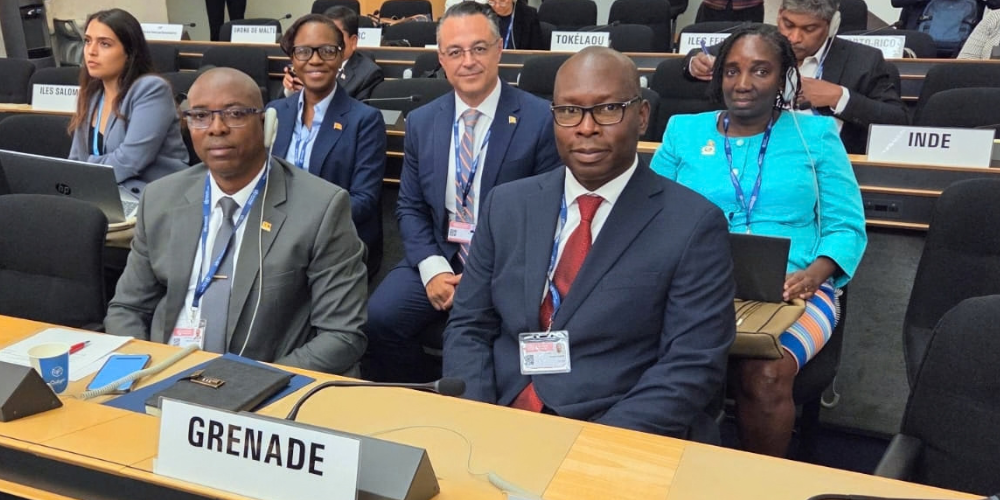
St. George’s University president and dean of the School of Medicine, Dr. Marios Loukas, served as a member of Grenada’s official delegation to the 79th World Health Assembly (WHA79), held in Geneva, Switzerland, from May 18–23. It marked the second consecutive year he has represented the University as part of the nation’s delegation.
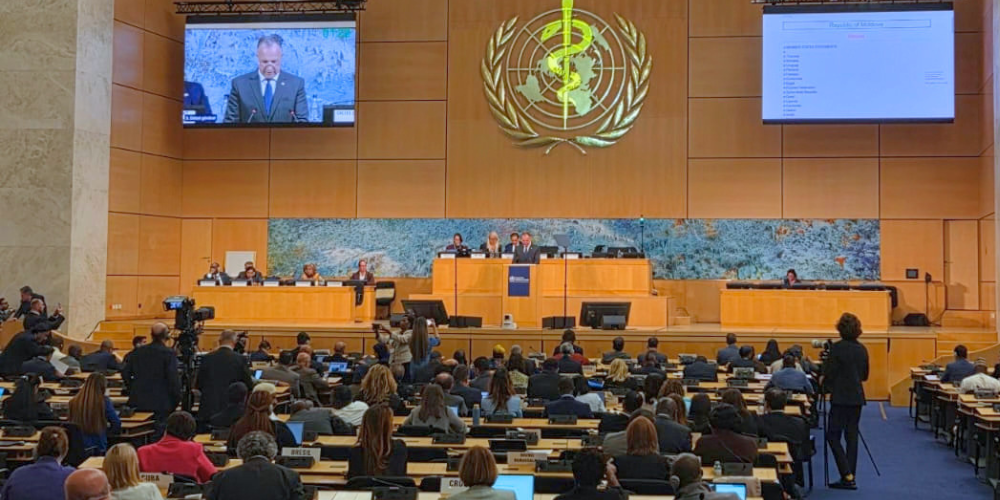
The World Health Assembly, the decision-making body of the World Health Organization (WHO), brings together representatives from WHO member states each year to address and establish global health priorities and shape international health policy. This year’s discussions addressed issues including noncommunicable diseases, health system resilience, climate and health, pandemic preparedness, health financing, and other pressing global health issues.
The delegation was led by Grenada’s minister for health, the Honorable Philip Telesford, and included chief medical officer Dr. Shawn Charles, director of medical services Dr. Tyhiesia Donald, and chief nursing officer Anoris Martin-Charles.
“Serving on Grenada’s delegation for a second consecutive year is both an honor and a responsibility,” Dr. Loukas said. “It reflects the close relationship between St. George’s University and Grenada and, importantly, the role that medical education, research, and workforce development can play in strengthening a nation’s health system and infrastructure.”
A seat at the table for small island states
Grenada joined other Small Island Developing States in bringing attention to health challenges that can be particularly acute in small nations, including the growing burden of noncommunicable diseases, climate-related threats to health and health infrastructure, workforce shortage, and the need for resilient sustainably financed healthcare systems.
For Dr. Loukas, participating in the Assembly provided an opportunity to bring the perspective of medical education and public health to conversations about the future of healthcare in Grenada and across the Caribbean.
“The challenges confronting Small Island Developing States are local manifestations of global problems,” Dr. Loukas said. “Climate change, chronic disease, workforce shortages, and health-system resilience do not stop at national borders. Grenada must have a voice in these conversations, and SGU has an important role to play in supporting the country and the wider Caribbean with education, research, and expertise.”
From medical education to health-system capacity
Dr. Loukas’s involvement reflects SGU’s long-standing role and broader contribution to health and public health in the region. The University’s Master of Public Health program is accredited by the Council on Education for Public Health (CEPH)—one of only a few CEPH-accredited programs located outside the United States. Through its medical, veterinary, public health, and graduate programs, SGU also contributes to the development of healthcare professionals and researchers working in Grenada, throughout the Caribbean, and internationally.
That regional commitment was strengthened in April 2026, when SGU formalized a five-year partnership with the Caribbean Public Health Agency (CARPHA) through a Memorandum of Understanding providing a framework for collaborative research, education, training, and workforce development across the Caribbean.
“One message comes through repeatedly in global health discussions: ambitious health policies ultimately depend on people,” Dr. Loukas said. “Whether we are talking about preventing noncommunicable diseases, preparing for future health emergencies, or building more resilient healthcare systems, we need a well-trained workforce. Universities therefore have an important responsibility not only to educate health professionals, but also to work alongside governments and public health organizations to address the needs of the communities we serve.”
“You cannot move a health system toward prevention without people trained to deliver it. That is the work we do at SGU every day.” — Dr. Marios Loukas
A shared vision for the region
Dr. Loukas’s participation in the World Health Assembly comes as SGU celebrates its 50th anniversary, offering a great example of how the University’s founding vision continues to emphasize the relationship between the University, Grenada, and the international health community.
Founded in Grenada in 1976, SGU has grown from a medical school into an international university whose graduates practice and contribute to healthcare systems around the world. At the same time, Grenada remains central to the University’s identity and mission. Today, SGU continues to strengthen its partnerships across the Caribbean and beyond, contributing its academic, research, and medical expertise to conversations shaping the future of global health.
“Fifty years ago, St. George’s University was founded on the belief that a university in Grenada could educate physicians who would make a difference around the world,” Dr. Loukas said. “Today, our responsibility extends even further. We have the opportunity to use our educational, scientific, and institutional capabilities to support Grenada and the Caribbean while contributing to the broader global health community.”
“Representing SGU alongside Grenada’s Ministry of Health at the World Health Assembly is a powerful reminder that our local and global missions are inseparable,” he added. “Grenada is our home, and as SGU enters its next 50 years, we want our partnership with the country and the region to become even stronger.”