
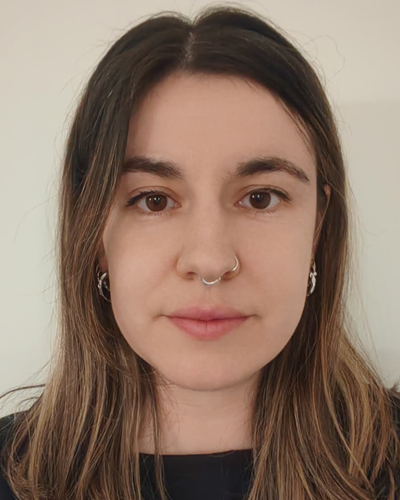
Andrea Higueruelo, BSc, MSc, PhD
Postdoc in the Department of Anatomy, Physiology, and Pharmacology
Biography
Dr. Higueruelo is a postdoctoral researcher in the School of Veterinary Medicine and part of the Aquatic Animal Medicine team at SGU. She will primarily focus on parasitology, while also directing SGU students in parasitological research.
Dr. Andrea Higueruelo Fernández earned her Bachelor’s degree in Environmental Science from the Autonomous University of Barcelona (2015–2019), where she also completed a Master’s degree in Terrestrial Ecology and Biodiversity Management in 2020. She then pursued an International Doctorate in Aquaculture, specialising in the research line of Pathology, Health, and Environmental Impact Assessment in Fish. She finished the PhD in 2025, with her thesis entitled “Sentinels of the sea, from catsharks to their parasites: A multidisciplinary study using Scyliorhinus canicula (Linnaeus, 1758) as a model species for assessing the surrounding environment”. During her PhD, Dr. Higueruelo completed a six-week research stay at the Spanish Institute of Oceanography (IEO-CSIC) in Vigo, where she conducted the determination and analysis of heavy metals in Mediterranean fish species. She also undertook a three-month international research stay at the Institute for Experimental Pathology, University of Iceland, studying the parasite fauna of Icelandic demersal elasmobranchs.
Contact Information
Areas of Interest
- Parasitology
- Marine ecology
- Marine pollution
Affiliations
- Universitat Autònoma de Barcelona (Barcelona, Spain)
Selected Publications
- Higueruelo, A., Schaeffner, B. C., Soler-Membrives, A., & Dallarés, S. (2026). Testimonial of ecological and biogeographic patterns: parasite assemblages of deepwater catsharks (Pentanchidae) in Icelandic waters. Parasitology, 1–44. https://doi.org/10.1017/S0031182026101632
- Higueruelo, A., Besada, V., Sánchez-Marín, P., Muns-Pujadas, L., Constenla, M., Dallarés, S., Carreras-Colom, E., Rodríguez-Romeu, O., & Soler-Membrives, A. (2025). A “toxic trio” (mercury, lead and cadmium) metal assessment in marine commercial species from Northwestern Mediterranean Sea: risk and recommendations. Environmental Research, 122022. https://doi.org/10.1016/j.envres.2025.122022
- Higueruelo, A., Constenla, M., Padrós, F., Sánchez-Marín, P., Carrassón, M., Soler-Membrives, A., & Dallarés, S. (2024). Coping with current impacts: The case of Scyliorhinus canicula in the NW Mediterranean Sea and implications for human consumption. Marine Pollution Bulletin, 201, 116200. https://doi.org/10.1016/j.marpolbul.2024.116200
- Higueruelo, A., Robles, P., Constenla, M., Dallarés, S., & Soler-Membrives, A. (2025). Novel Insights into the Reproductive Strategy of the Small-Spotted Catshark, Scyliorhinus canicula (L.) in the Northwest Mediterranean: A Year-Long In-Depth Study. Ichthyology & Herpetology, 113(4). https://doi.org/10.1643/i2025001
- Higueruelo, A., Santín, A., Salazar, J., Ambroso, S., Soler-Membrives, A. & Grinyó, J. (2023). Coexistence of megabenthic assemblages and artisanal fishers: The case of Cap de Creus Marine Protected Area (North-Western Mediterranean Sea). Marine Environmental Research, 192, 106211–106211. https://doi.org/10.1016/j.marenvres.2023.106211
Selected Projects
- Conservation of ancient relationships: Integrative approach using marine fish assemblages and their parasites to assess ecosystem health” PI: BC Schaeffner & D Marancik Windward Islands Research & Education Foundation (WINDREF): One Health Research Initiative (OHRI) grant number: OHRI 02-03-25
SVM Research Faculty
View the SVM faculty involved in research and SVM Adjunct and Cooperating faculty who collaborate with SVM researchers. SVM faculty also collaborate with many other researchers at institutions in North and South America, Europe, Africa and Asia. These collaborations are reflected within the individual SVM faculty research profile.