
If you’re considering a career in medicine, one of the first decisions you’ll encounter is whether to pursue a Doctor of Medicine (MD) or Doctor of Osteopathic Medicine (DO) degree. While the terms “doctor” and “MD” are often used interchangeably, they aren’t the same. Licensed physicians in the United States can earn either an MD or a DO degree, and both provide a path to practicing medicine.
The biggest difference between an MD and a DO is their approach to patient care. MDs practice allopathic medicine, which focuses on diagnosing and treating disease using evidence-based medicine. DOs receive the same foundational medical training but also study osteopathic principles, which focus on holistic care, and receive additional instruction in osteopathic manipulative treatment (OMT).
Both MDs and DOs are fully licensed physicians who can prescribe medication, perform surgery, complete residency training, and pursue nearly every medical specialty.
This guide compares MD and DO programs — including medical school, residency, licensing exams, salary, and career opportunities — to help you determine which path best aligns with your goals.
MD vs. DO: Allopathic vs. Osteopathic Philosophies
Allopathic (MD) and osteopathic (DO) medical schools both teach students the scientific foundations needed to become licensed physicians, but they take different approaches. Most people are familiar with allopathic medicine, which focuses on diagnosing and treating disease using evidence-based medicine.
Some people ultimately choose to pursue allopathic medicine because it’s the only type they know, which was the case for SGU graduate Dr. Benjamin Stueben, a pathologist and researcher. “To be honest, my dad’s side of the family were mostly MDs, so I didn’t put any thought into going for a different degree,” he explains. “In fact, I didn’t really learn what a DO was until I had already started medical school.”
There’s clearly a difference between MD and DO philosophies, so what is a DO, exactly? Osteopathic medicine takes a more holistic approach, emphasizing preventive care and treating the whole person. DOs also learn osteopathic manipulative treatment (OMT), a hands-on technique used to help diagnose, treat, and prevent certain musculoskeletal conditions.
This whole-body approach is often one of the biggest reasons an individual ends up choosing to become a DO.
MD vs. DO: Medical school requirements and training
Getting into medical school takes hard work, whether you choose an MD or DO program. Both pathways are academically rigorous and look for applicants with strong grades, competitive MCAT scores, clinical experience, and a demonstrated commitment to medicine.
According to the Association of American Medical Colleges (AAMC), students matriculating into U.S. MD-granting medical schools for the 2025–2026 academic year had an average MCAT score of 512.1 and an average GPA of 3.81.
While admissions metrics may differ somewhat between MD and DO programs, both pathways prepare students to become licensed physicians.
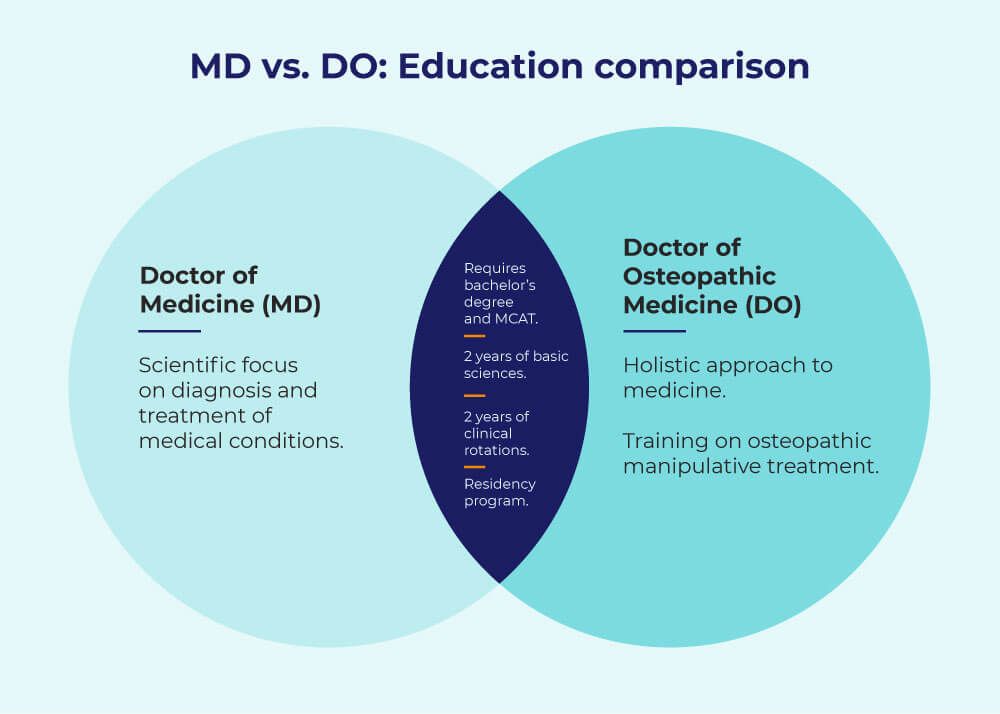
Both MD and DO programs typically last four years and include foundational medical science coursework followed by clinical rotations. The primary educational distinction is that DO students also receive additional training in osteopathic manipulative treatment (OMT), a hands-on approach used to help diagnose, treat, and prevent certain musculoskeletal conditions. Most DO programs include approximately 200 hours of OMT instruction.
Dr. Jill Garripoli Pedalino, a pediatrician and owner of Healthy Kids Pediatrics, says this training helps students better understand how the body’s systems work together. “We learned that the body is completely interconnected and that there are manual techniques to help a person restore their optimal health,” she explains.
Researchers continue to study the effectiveness of osteopathic manipulative treatment across a variety of conditions. While evidence is stronger for some uses than others, studies suggest OMT may provide benefits in certain clinical situations. One review, for example, found that premature infants receiving OMT experienced shorter hospital stays.
MD vs. DO: Residency and licensing exams
The real distinction between DO and MD programs used to be most apparent when it came to residency and licensing exams, but that has changed. Historically, students at allopathic medical schools took the United States Medical Licensing Examination (USMLE) series, while osteopathic medical students took the Comprehensive Osteopathic Medical Licensing Examination (COMLEX-USA) sequence to qualify for residency programs.
According to the 2025 National Resident Matching Program (NRMP) Main Residency Match, US MD seniors matched into residency at a rate of 93.5%, while US DO seniors matched at 92.6%. These results show that graduates from both MD and DO programs have strong opportunities to match into residency training.

While national Match statistics provide helpful context, it’s also important to evaluate an individual medical school’s residency outcomes. In the 2026 residency Match, more than 800 SGU students and graduates secured US residency positions across 23 specialties in 43 states and the District of Columbia. Prospective students can explore additional residency placement data, USMLE performance, and graduate outcomes on SGU’s School of Medicine Facts & Figures page.
MD vs. DO: Salary and career outlook
You may be wondering whether there’s a pay difference between MD and DO degrees. In most cases, your earning potential depends far more on your area of specialty as a physician, practice setting, geographic location, and years of experience than on whether you hold an MD or DO degree. Both MDs and DOs can practice medicine, prescribe medication, perform surgery, and pursue careers across nearly every medical specialty.
In general, DOs tend to pursue primary care specialties more often than MDs. According to the American Medical Association (AMA), approximately 57% of practicing DOs work in primary care, compared with about one-quarter of MDs. That said, both MDs and DOs practice in every medical specialty, from family medicine and pediatrics to surgery, radiology, anesthesiology, and emergency medicine.
What degree path should you follow?
You are now equipped with some important information to help you decide between MD versus DO programs, but Dr. Stueben advises, “For those deciding between MD or DO programs, I’d apply to both and base your decision not on the degree, but on all the other factors that go into choosing a school.”
Choosing a medical school is a significant life decision, so take time to research each program carefully. Learn how to evaluate your options by reading our blog post, “How to Choose a Medical School: 9 Things to Evaluate Before Accepting” , or register for an SGU Virtual Information Session to learn more about SGU’s MD program and admissions process.
*TThis article was updated from April 2021 with the most recent facts and figures available.