The musculoskeletal system (MSK) is often one of the first areas where students begin to appreciate the connection between structure and function in medicine. Bones, muscles, joints, nerves, and connective tissues support posture, protect vital organs, assist with circulation, and influence nearly every physical interaction a patient has with the world. At St. George’s University (SGU), the MSK module introduces students to this essential area of medicine through an integrated approach that connects anatomical knowledge with clinical reasoning, practical skills, and professional development.
Why MSK matters in medical education
The MSK system provides an ideal foundation for helping students think like future physicians. It is highly visual, clinically relevant, and immediately applicable to patient care. A student who understands the anatomy of the shoulder, for example, will be better prepared to interpret pain patterns, assess range of motion, and understand injuries involving muscles, tendons, ligaments, and nerves in future practice.
The MSK module is designed as an interdisciplinary study of the anatomical, histological, physiological, developmental, and pharmacological principles of the skeletal and muscular system. This matters because patients do not approach physicians with isolated textbook concepts. They show up with pain, weakness, swelling, limited movement, trauma, or functional decline. To understand those concerns, students must be able to connect what they see in the anatomy lab with what they learn in physiology, histology, development, and clinical skills.
This type of integration helps students push their understanding beyond memorization. Instead of learning a list of muscles or bones in isolation, they begin asking deeper questions: What does this structure do? What happens when it is injured? How would this affect movement? What clinical findings should I expect? The ability to seek out this level of information is central to establishing strong clinical reasoning.
How students engage with the MSK curriculum
One of the strengths of the MSK module is that students encounter the material in multiple ways. While lectures and didactic sessions provide the conceptual framework, case studies, practical laboratory sessions, and small group discussions are integral components of the module. This combination allows students to apply foundational knowledge to clinically based scenarios.
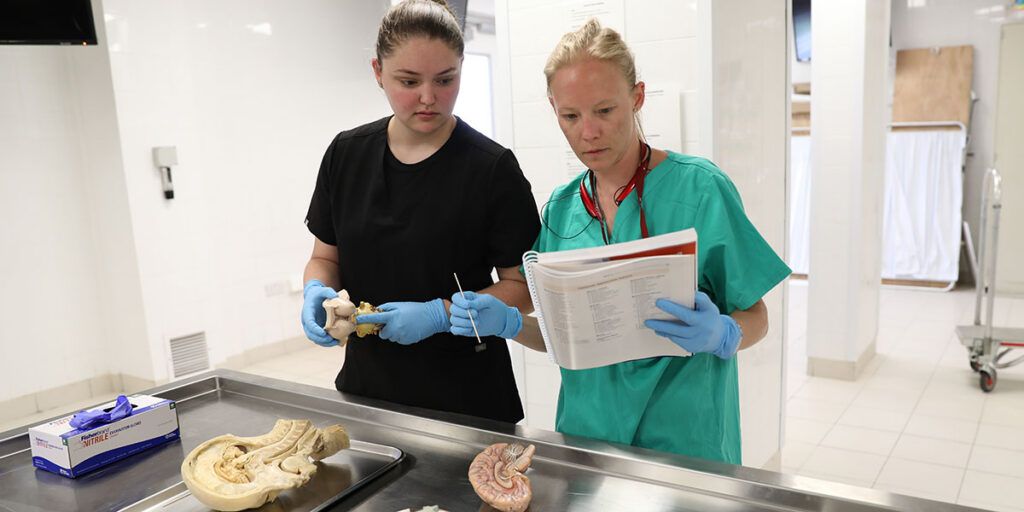
Cadaveric prosections are especially valuable in helping students understand three-dimensional relationships. In anatomy, spatial understanding is essential. Seeing the relationship between muscles, nerves, vessels, joints, and fascial planes helps students appreciate how the body is organized and why injuries or disease processes may produce specific clinical signs.
The module also incorporates ultrasound sessions with standardized patients, an important bridge between anatomy and clinical practice. Ultrasound allows students to visualize structures in a living person, reinforcing that anatomy is not only something learned in a laboratory, but rather key information physicians use in real time to guide examination, diagnosis, and patient care.
Small groups and practical sessions also give students opportunities to strengthen communication, teamwork, and professional behaviors. These skills are not separate from medical knowledge. They are part of how future physicians learn to work with colleagues, communicate observations clearly, and approach patient care with professionalism.
What students should gain
By the end of the MSK module, students should be able to identify gross anatomical and microscopic structures, understand normal development and physiological function, and apply their knowledge to hands-on clinical exercises. Just as importantly, they should begin developing confidence in connecting basic science to patient-centered thinking.
This module is more than an introduction to bones and muscles. It is an opportunity for students to practice the habits that will serve them throughout medical school: observing carefully, asking thoughtful questions, integrating information across disciplines, and recognizing the limits of their own knowledge. The broader course objectives of the Basic Principles of Medicine also emphasize self-assessment, goal setting, lifelong learning, and the ability to identify updated knowledge that may improve outcomes.
That reflective component is important. Medical knowledge continues to evolve, so students must learn how to identify gaps, seek appropriate resources, and continue improving. The musculoskeletal curriculum supports this development by combining foundational content with active, clinically relevant learning experiences.
Building a foundation for future clinical practice
MSK is central to so many areas of medicine, including primary care, emergency medicine, orthopedics, rheumatology, neurology, rehabilitation, sports medicine, and geriatrics. Even students who do not pursue a musculoskeletal specialty will inevitably care for patients with back pain, joint pain, fractures, arthritis, mobility limitations, or occupational injuries.
For this reason, the Musculoskeletal System module plays an important role in preparing students for the clinical years and beyond. It helps them understand the body as an integrated system and gives them early experience applying scientific knowledge in practical, patient-centered ways.
For students beginning their medical education, the MSK curriculum is often a reminder that medicine is both detailed and deeply human. Every structure has a function, every movement has a purpose, and every patient story offers an opportunity to connect knowledge with care.