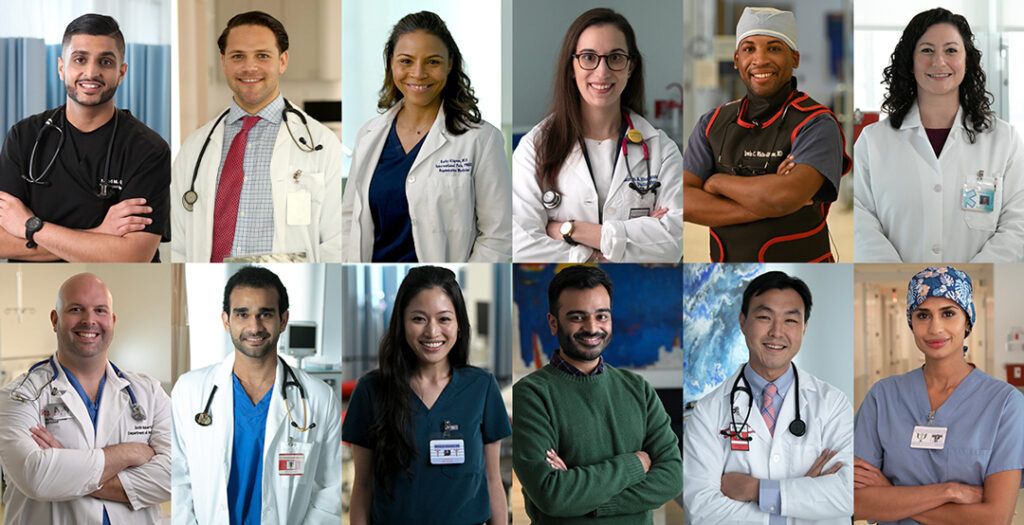
Career shifts can happen in any industry, and the medical field is no exception. St. George’s University (SGU) has welcomed career changers from all walks of life, including photographers, pilots and even martial arts fighters. So, nurses, emergency medical technicians (EMTs), and paramedics can most definitely become doctors. Transitioning from a clinical role to a physician role may not be common, but it happens regularly enough. You also have a considerable advantage in pursuing an MD if you already have both educational background and field experience in medicine. Keep in mind, however, that this is a pivot— not a promotion, so you still would have to apply to medical school and attain the proper degree and training. Let’s look at how these pathways work and how to leverage your experience to earn your white coat.
Can nurses become doctors? The nurse to MD path
Simply stated, yes, nurses can and do become doctors every single year. But, there are no “bridge programs” that result in a faster shift from Registered Nurse (RN) to Medical Doctor (MD). You must complete a full medical school curriculum just as any other medical student would.
BSN vs. ADN: the starting point
The path from nurse to MD almost always requires a bachelor’s degree. If you already have your Bachelor of Science in Nursing (BSN), you are halfway there. However, you’ll need to have satisfied specific science prerequisites that aren’t always part of nursing school.
If you have an Associate’s Degree in Nursing (ADN), you’ll need to complete your bachelor’s degree first. Many nurses will do this through an RN-to-BSN or RN-to-BS program while they continue to work.
Core requirements for nurses
Core curriculum prerequisites for medical school: Admissions committees are known to look favorably on nurses from high-acuity backgrounds like the ICU, ER, or Flight Nursing because these roles demonstrate rigorous training and proven clinical experience. Nevertheless, you will still need to satisfy a number of academic requirements, including completing medical school prerequisites, such as two semesters each of biology, general chemistry, organic chemistry, and physics.
The MCAT exam
The MCAT tests “how to think like a scientist” – in other words, testing scientific inquiry and reasoning skills – which is fundamentally different from the “how to act as a clinician” focus of the National Council Licensure Examination (NCLEX). Be sure to prepare thoroughly for your MCAT exam, even if you have passed the NCLEX with flying colors, as your score is a critical component of determining your admission to medical school. Students who have taken both exams often report that the MCAT covers a broader array of topics, and is a longer and more difficult exam.
Applying to medical school
The application process when applying to medical school is extensive, so it’s worth looking into schools like SGU that offer support services as needed to help guide you every step of the way.
Nurse to MD path: timeline, cost, and reality check
A realistic Nurse to MD path usually takes about seven to 10 years. That includes one to two years of completing prerequisites and MCAT prep, four years of medical school, and three to seven years of residency training.
Paying for medical school can be challenging for many, but as a nurse, you are also stepping away from your salary for at least four years. But while many students will rely on federal loans, nurses often do well with landing scholarships thanks to their real-world clinical experiences and ability to articulate those in their applications.
While an academic reset can feel like starting over, nurses tend to have a “clinical narrative” that traditional students do not. When you write your personal statement, you aren’t talking about wanting to help people, you’re sharing how you’ve actually done it! This level of experience and maturity is a considerable edge for impressing admissions committees.
Can EMTs and paramedics become doctors? The EMT to doctor pathway
EMTs can also become doctors and the transition is actually one of the most common “non-traditional” routes in the medical field. Medical schools tend to value the “grit” found in EMTs based on their real-life experiences on the job, like making decisions at a trauma scene or in the back of a moving ambulance with limited resources. This shows composure that will be necessary as a doctor.
EMT vs. paramedic readiness
EMTs making the pivot will often use their certification as a high-quality gap-year activity. But while this certification provides excellent patient contact hours, you will still be required to complete a full four-year degree as well.
Paramedics, meanwhile, often have more advanced clinical knowledge, like EKG interpretation or ACLS certification, but, like nurses, they’ll still need to complete medical school prerequisites.
PA to MD path vs. Nurse to MD path: key differences
Many Physician Assistants (PAs) eventually consider the PA to MD path. While PAs have the most educational overlap with doctors, the transition is uniquely challenging. Here is a breakdown of the PA to MD and Nurse to MD pathways:
Feature |
Nurse to MD |
PA to MD |
|---|---|---|
Science Overlap |
Moderate (mostly clinical) |
High (uses the medical model) |
Admission View |
Seen as a major shift in philosophy |
Sometimes asked, “Why not just stay a PA?” |
Fast-track? |
None (4 years) |
Very few (LECOM has a 3-year bridge) |
Is becoming a doctor worth it after a healthcare career?
This is a very personal decision, but before you commit, you must assess if becoming a doctor will satisfy what you are seeking in your career. A professional who wants ultimate diagnostic authority, has a desire to lead research, or possesses a passion for a specialty that is only open to physicians (like neurosurgery), would be examples of what a satisfactory career might look like. On the other hand, if your goal is a higher salary or more autonomy, becoming a Nurse Practitioner (NP) or Certified Registered Nurse Anesthetist (CRNA) might satisfy your goals in half the time with less debt. One career changer who attended SGU captured this sentiment perfectly when reflecting on the move. “I realized that while [my previous career] gave me stability, it didn’t give me fulfillment,” he stated. “Ultimately, I hope to combine my business acumen with medical expertise to improve patient outcomes and strengthen healthcare delivery models…”
It’s worth noting that admissions committees will look for indicators of “burnout.” If your application suggests you are becoming a doctor to avoid taking orders, it might send the wrong message. It is essential to frame your desire to pivot as moving toward physician-level responsibility, rather than moving away from nursing or EMS.
Is the doctor path right for you?
So, can nurses become doctors? Absolutely. So can EMTs, paramedics, and PAs. You just need to be willing to put in the work. One student marveled at the various life experiences of the people seen at SGU, stating, “…There were students who weren’t fresh out of college – they were PAs, EMTs, lawyers, all going back to medical school…”
And it is fair to say that the medical field can definitely benefit from physicians who have spent years at the bedside or in the back of an ambulance. Your experience isn’t just a line on a resume; it’s the foundation of your bedside manner and clinical intuition.
The path is not easy, but if this is your calling and you are willing to go back to school, it’s worth pursuing! If you need assistance with your decision or have questions about any aspect of the medical school timelines, SGU is here to help!
Have another question? Request more information today!
Frequently Asked Questions (FAQs)
Can nurses become doctors without going back to school full-time?
No. Nurses cannot become doctors without completing medical school There are no shortcut or bridge programs that allow RNs to skip medical school. Nurses must complete all medical school prerequisites, take the MCAT, attend four years of medical school, and complete residency training just like any other applicant.
How long does the nurse to MD path typically take?
The nurse to MD path generally takes 7–10 years. This includes completing any missing science prerequisites (1–2 years), four years of medical school, and three to seven years of residency depending on the specialty. Nurses with a BSN who already meet science requirements may be able to shorten the pre-med portion of the timeline.
Can EMTs become doctors, and is EMT experience helpful for medical school?
Yes, EMTs can become doctors. EMT experience is often viewed favorably by admissions committees because it demonstrates hands-on patient care, decision-making under pressure, and real clinical exposure. However, EMTs must still complete a four-year bachelor’s degree and all required pre-med science coursework before applying to medical school.
Is the PA to MD path faster than the nurse to MD path?
Not significantly. While physician assistants are trained in the medical model and may have more science overlap, they still must complete medical school and residency. A few limited bridge options exist, but most PA to MD path transitions require the full four-year medical school curriculum.
Is becoming a doctor worth it after working as a nurse or paramedic?
That depends on your goals. If you seek full diagnostic authority, leadership in patient care decisions, or access to physician-only specialties, pursuing an MD may be worth the time and financial investment. However, advanced practice roles like Nurse Practitioner (NP) or CRNA may provide greater autonomy with less debt and a shorter training timeline.