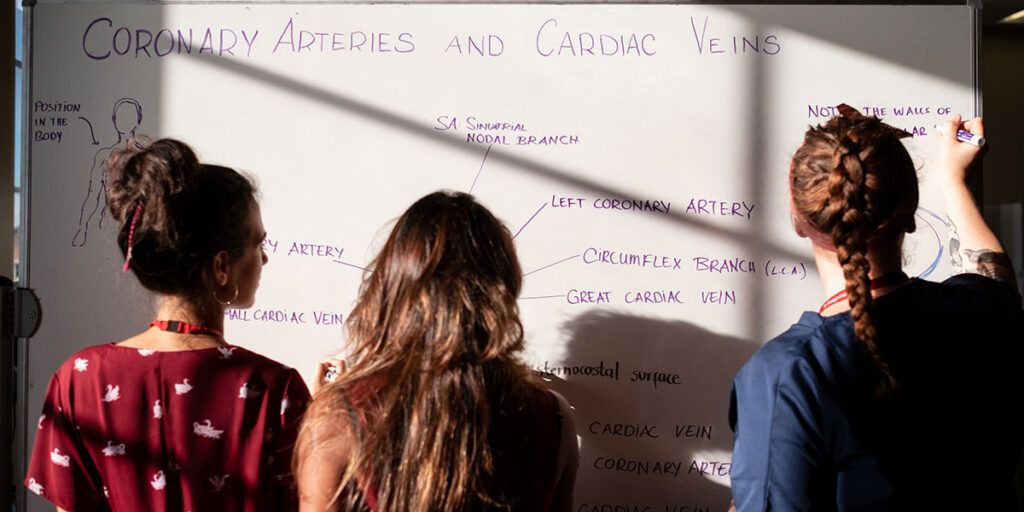
The Cardiovascular, Pulmonary, and Renal Systems (CPR) Module is well known as the final module of the first semester of medical school. Over seven weeks, students participate in a variety of learning activities designed to help them understand the functions of these essential organ systems and how they work together to maintain health.
Building on concepts from previous modules, students deepen their understanding of how the body functions in both health and disease. While the CPR Module is academically challenging, it is also one of the most exciting parts of the first semester. For many students, this is the point at which medical school begins to feel like practicing medicine.
The cardiovascular system – Do you know someone with high blood pressure or a heart condition?
Cardiovascular disease is the leading cause of death globally [1], making the cardiovascular portion of the module highly relatable for many students. Chances are that students know someone who has high blood pressure, has suffered a heart attack or stroke, or lives with another heart condition.
As students explore the heart and blood vessels from multiple perspectives, they physically examine these structures in the cadaver lab and investigate the microscopic features in histology sessions. They also learn the physiology and biochemistry that explain the significance of blood, how the heart pumps it and how the vessels transport it throughout the body.
The opportunity to apply this knowledge makes the experience even more engaging. In clinical skills sessions, students practice measuring blood pressure and performing cardiovascular examinations on standardized patients. Imagine learning how blood pressure is regulated in the classroom and then applying that knowledge in a later session. Experiences like these help students connect scientific concepts to patient care and prompt them to begin thinking like future physicians.
Pulmonary (respiratory) system – Have you ever noticed how your breathing changes after exercise?
After exploring the cardiovascular system, the focus then shifts to the pulmonary or respiratory system. Students examine the anatomy of the lungs and airways while exploring the microscopic structures that make respiration possible. They learn the physiology behind breathing and the biochemistry that explains how gases are transported in the blood. Students discover how the respiratory system delivers oxygen to the body and removes carbon dioxide. Although these concepts may initially seem complex, they quickly become relatable through everyday experiences.
Think about the last time you climbed several flights of stairs or physically exerted yourself. The rapid breathing that follows is something most people have experienced. During this section of the module, students learn why those changes occur and how the body responds to increased demands for oxygen.
As students gain a deeper understanding of how healthy lungs function, they also learn about the effects of smoking and other harmful exposures. This helps transform scientific knowledge into a practical understanding of health and disease.
Renal system – What do you know about the kidneys, and why do kidney transplants matter?
The CPR Module concludes with the renal system, which includes the kidneys, bladder, and associated tubular structures. This section serves as an excellent capstone because it highlights how closely the body’s organ systems work together.
Students learn how the kidneys continuously filter blood to produce urine and maintain the body’s internal balance. They also discover how the kidneys work alongside the cardiovascular and respiratory systems to regulate blood pressure, fluid balance, and pH.
While kidney disease may be less familiar than heart disease, many students recognize the importance of dialysis and kidney transplantation. They also learn that kidney damage is a common complication of cardiovascular disease. These connections reinforce an important lesson: medicine is not about studying organs in isolation; it is about understanding how different systems interact to support health.
Final thoughts
For many students, the CPR Module represents an important turning point in their medical education. The content is challenging but also rewarding because it connects directly to conditions that students recognize from everyday life. As the pieces begin to fit together, students move beyond memorizing facts and start understanding how the human body functions as an integrated whole.
More importantly, they begin to see how the science they are learning today will help them care for patients in the future. By building a strong foundation of knowledge about cardiovascular, pulmonary, and renal systems, students prepare themselves for the study of related diseases and the practice of clinical medicine in the years ahead. The CPR Module is often the first moment when students truly begin to feel like they are learning medicine.
Ready to begin your pathway to becoming a physician? Explore your options with SGU today.
1 Cardiovascular diseases (cvds) (2025) World Health Organization. Available at: https://www.who.int/news-room/fact-sheets/detail/cardiovascular-diseases-(cvds) (Accessed: 01 June 2026).